Hand embroidery vs machine embroidery is the question we hear most at our counter, and one customer shows exactly why. She walked into our shop in Al Mujarrah holding a jalabiya she’d bought for her sister’s engagement. She’d paid for “hand work.” We turned it inside out, and within ten seconds we both knew it had come off a machine.
She wasn’t upset about the dress. She was upset that nobody had told her the truth.
That’s why we wrote this. Hand and machine embroidery can look surprisingly similar from the front, but they aren’t the same thing, and they shouldn’t cost the same. Here’s how we tell them apart, and how you can too.
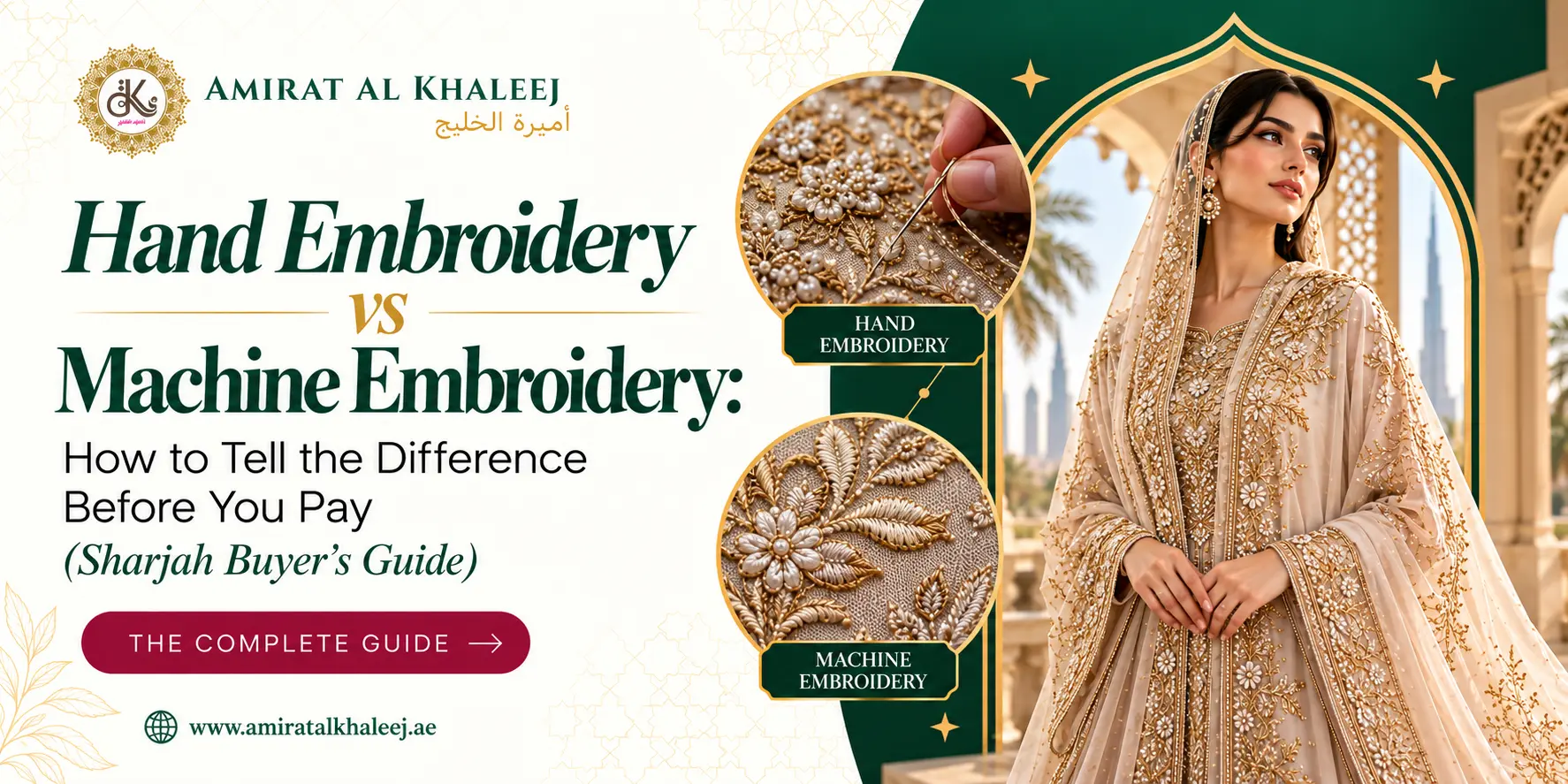
The short version: hand embroidery is stitched with a needle by a person, so no two stitches are exactly alike. Machine embroidery follows a digital file, so every stitch is a perfect copy of the last. Flip the fabric over. Knots and slightly wandering threads mean handwork. A tidy, mirror-image pattern stuck to a stiff backing usually means a machine.
What’s the actual difference between hand and machine embroidery?
With hand embroidery, one of our artisans sits at a wooden frame with a needle, thread and the fabric pulled tight. Every stitch goes in by hand. A detailed neckline can take her most of a day, sometimes longer.
Machine embroidery works differently. Someone loads a design file, hoops the fabric, and presses start. The machine does the rest, usually in under an hour.
We do both, and honestly, both have their place. Machine work isn’t “cheap” in a bad way. It’s just a different product. The trouble only starts when one is sold as the other.
7 ways to tell hand embroidery from machine embroidery
You don’t need years of experience for this. These are the same checks we’d do if you handed us a dress across the counter.
- Turn it inside out. Start here, always. The back of hand embroidery looks a little messy, with knots, tails of thread, and lines that drift. A machine leaves a neat copy of the front design.
- Feel for a stiff patch. Most machine work is stitched over a stabiliser, a papery white or black sheet that stays stuck to the back. If it crinkles, it’s probably a machine.
- Follow one line of stitches. In hand work, some stitches are a touch longer, some a touch shorter. Machines don’t make that mistake.
- Compare the two sleeves. Same flower on each side? Look closely. A person never stitches it exactly the same twice.
- Run your fingers over it. Good handwork, especially gold thread and zardozi, stands up off the fabric. You can feel it. Machine designs tend to sit flatter and feel denser.
- Check the edges. Machine satin stitch has razor-sharp borders. Hand-stitched outlines are a bit softer.
- Be suspicious of a bargain. If a heavily worked bridal piece costs the same as a plain abaya, someone isn’t paying an artisan.
One more thing you can do: ask to see a piece that’s still on the frame. Any shop that really does hand work will be glad to show you. We always are.
Hand embroidery vs machine embroidery: side-by-side comparison
If you’d rather see it all in one place, here’s how the two compare.
| Feature | Hand embroidery | Machine embroidery |
|---|---|---|
| How it is made | Needle and thread, by an artisan | Computerised machine from a digital file |
| Stitch consistency | Slight natural variation | Every stitch identical |
| Back of the fabric | Knots, thread ends, irregular paths | Uniform pattern, often a backing sheet |
| Texture | Raised, dimensional, soft | Flatter, denser, stiffer |
| Time to make | Days to weeks, depending on detail | Minutes to hours |
| Price | Higher (labour-intensive) | Lower |
| Uniqueness | Every piece is one of a kind | Identical copies |
| Repairs | Can be repaired stitch by stitch | Harder to repair invisibly |
| Best for | Bridal wear, Eid outfits, jalabiyas, heirloom pieces | Uniforms, logos, bulk orders, everyday wear |
How much more does hand embroidery cost in the UAE?
More, and there’s no getting around it. You’re paying for someone’s hours and skill, not machine time.
What moves the price most is how much of the garment gets covered. A simple border around the neck is one thing. A bridal bodice covered edge to edge is something else entirely. After that, it comes down to the thread (silk, zari and zardozi metal work all cost more), whether you want stones or beads added, and the fabric itself. Chiffon and silk need slower hands.
To give you a rough idea, across the UAE, a simple everyday jalabiya usually costs somewhere around AED 150 to 300. Once you get into proper embroidery, prices tend to sit between AED 500 and 1,500 (source). Heavy hand work on bridal pieces can go well past that, depending on how much is covered and what thread is used.
The easiest way to get a real number is to send us a photo of the design you like on WhatsApp. We’ll quote it before anyone picks up a needle.
When machine embroidery is actually the better choice
We’d be lying if we said hand work is always worth it. It isn’t.
If a school needs forty uniforms with the same crest, a machine is the right tool. Same goes for logos, lettering, staff wear, or matching outfits for the whole family. When every piece has to look identical and be ready in two days, hand embroidery would only slow you down and cost you more.
It also makes sense for clothes you’ll wear and wash every week. Save the handwork for the pieces people will photograph, remember, and maybe pass down.
If a tailor always pushes you toward the more expensive option, ask why.
Which outfits are worth hand embroidery?
Think about the days you’ll look back on.
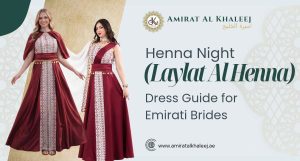
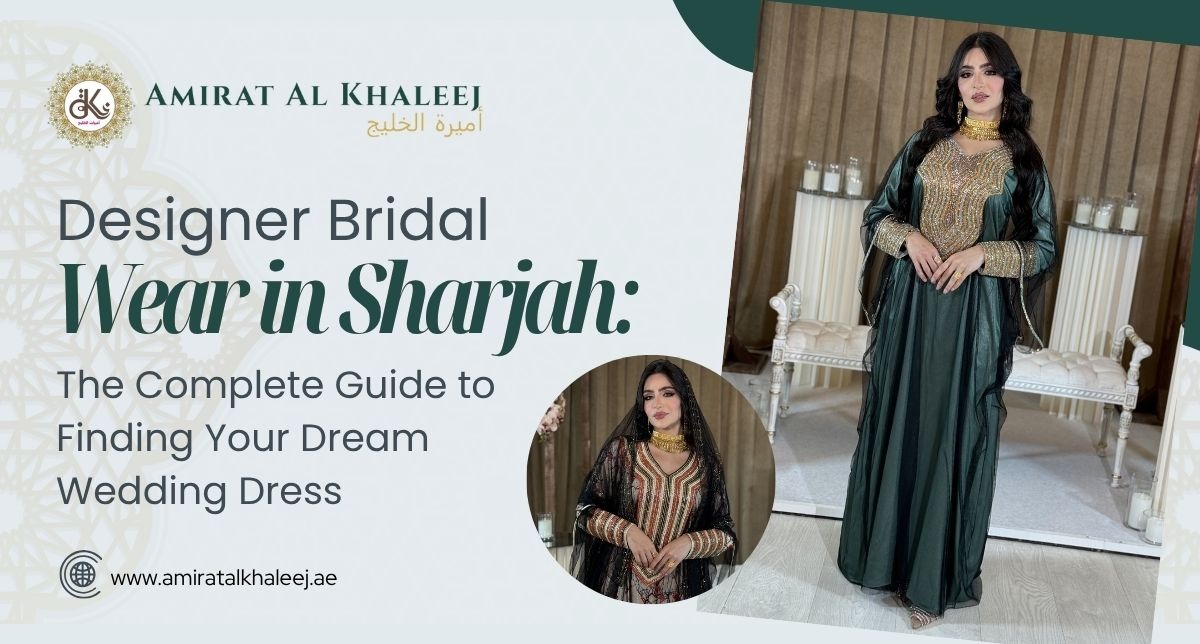
Bridal, engagement, and henna outfits come first for most of our customers. Those pieces get photographed up close, and handwork has a depth that cameras pick up. You can see some of it in our bridal collection.
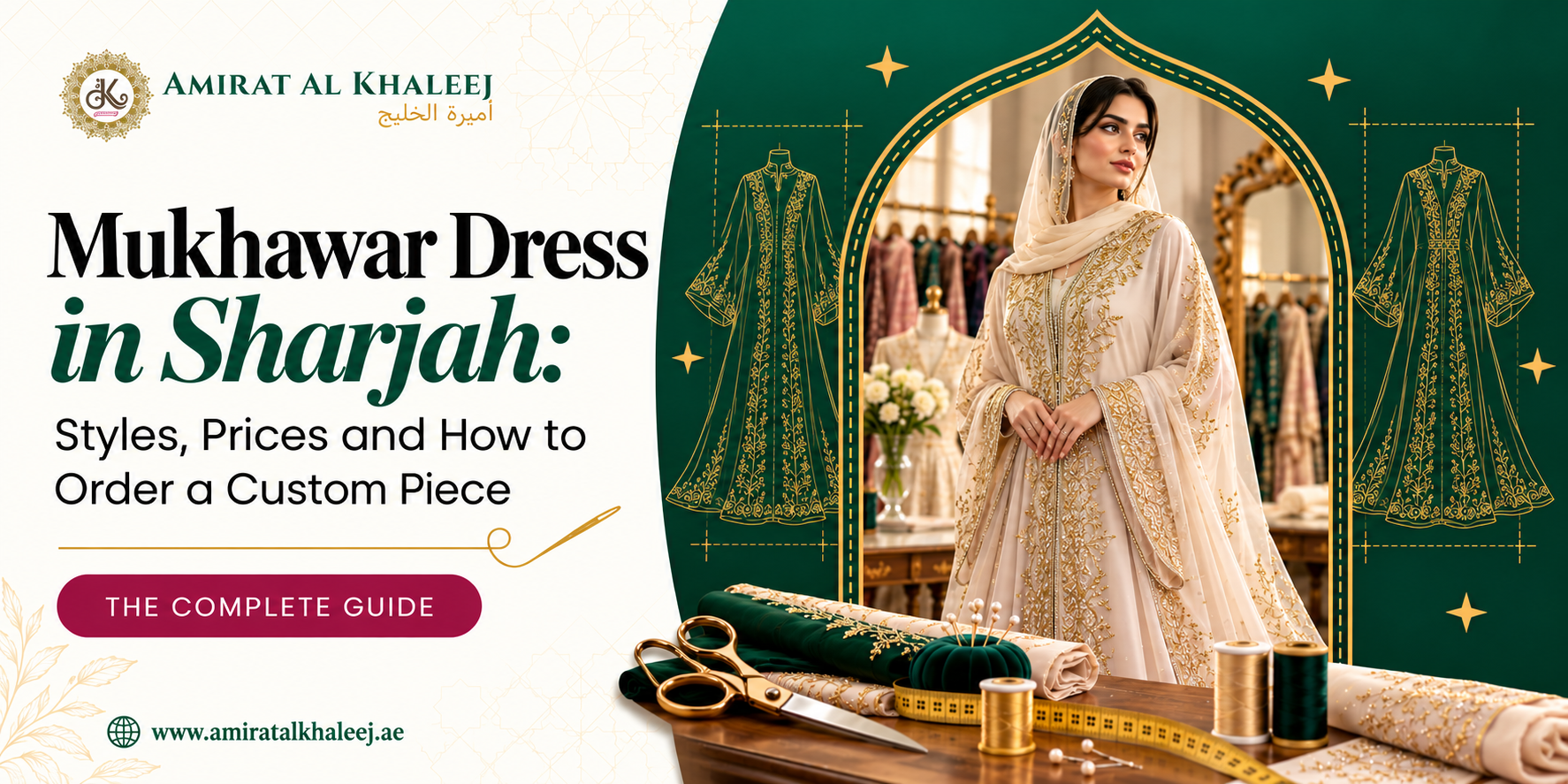
A jalabiya is another one. Plain, it’s comfortable. With a hand-stitched neckline and sleeves, it’s the outfit people ask you about at Eid. The same is true of mukhawar, which has always been known for its embroidery (we wrote more about that in our designer mukhawar guide), and of occasion kaftans, which we cover in our kaftan tailoring guide.
Evening gowns are the last on our list. Hand beading catches the light differently when you move.
How long does hand embroidery take?
It depends on how much you want stitched. A neckline is quick. A full bridal piece is not.
As a general guide, an embroidered neckline usually takes two to four days. A fully worked jalabiya is more like one to two weeks. Detailed bridal pieces can take three to six weeks, sometimes longer when the season is busy.
In a hurry? We do take 48-hour rush orders, but we’ll be straight with you about what’s realistic. Smaller, simpler designs can be done in that window. Heavy bridal work can’t be rushed without the quality dropping, so if your wedding is coming up, talk to us a few weeks ahead.
Looking after hand embroidery in UAE heat
Summer here is hard on delicate thread. Heat, humidity, and a generous spray of oud can all dull gold work over time.
A few habits help a lot. Put your perfume on before you get dressed, not straight onto the embroidery. Dry clean, or hand wash in cool water without wringing the stitched parts. When you iron, turn the piece over and lay it on a soft towel so you don’t crush the stitches.
For storage, skip the plastic cover. A cotton bag lets the fabric breathe, and a sheet of tissue paper between folds stops the embroidery rubbing against itself. Heavier pieces are happier on a padded hanger.
And if a thread comes loose, bring it in early. It’s a five-minute fix now and a much bigger job later.
What to ask before you pay
Whichever shop you go to, ask these. A good one won’t mind.
- Is this all hand work, all machine, or a mix?
- Can I see the back of something you’ve already finished?
- What thread are you using?
- When will it be ready, and can you do it faster if I need it?
- Is the price fixed before you start? How much is the deposit?
- If something comes loose later, will you fix it?
If the answers are vague, or you get a lot of “don’t worry, it’s fine,” keep looking.
Questions we get asked a lot
How can I tell if embroidery is done by hand?
Look at the back. Hand work leaves small knots and slightly uneven threads. Machine work looks neat and identical, often with a stiff backing sheet behind it.
Why does hand embroidery cost more?
Because a person spends hours, sometimes days, on it. A machine can do a similar design in a fraction of the time.
Does hand embroidery last longer?
It can, and it’s easier to repair. If one stitch goes, we can redo just that stitch. Look after it well and it’ll outlast most of your wardrobe.
Is gold thread or zardozi always done by hand?
No, and this one catches a lot of people out. There are machine versions with metallic thread. Real zardozi feels raised and heavy when you touch it.
Can you add embroidery to a dress I already have?
Usually, yes. Bring it in, and we’ll look at the fabric and tell you what’s possible.
Do you do rush orders in Sharjah?
We do, within 48 hours for smaller designs. Detailed bridal pieces need more time, and we’d rather tell you that upfront.
Come and see the work for yourself
Our artisans stitch with silk and gold thread, using techniques from both the Gulf and South Asia. Whatever you order, we’ll tell you plainly whether it’s hand work, machine work, or a bit of both before you pay a dirham.
You’ll find us on Abdullah Bin Salam Street, near Darwish Mosque in Al Mujarrah, Sharjah. We’re open Saturday to Thursday, 8 AM to 12 PM and again from 4 to 11 PM, and closed on Fridays. Our team speaks Arabic, Hindi, Urdu, and Bengali, and we deliver anywhere in the UAE.
Got a design in mind? Send us a photo on WhatsApp or call +971 56 722 6191, and we’ll tell you what it’ll take. You can also browse our hand embroidery page first.