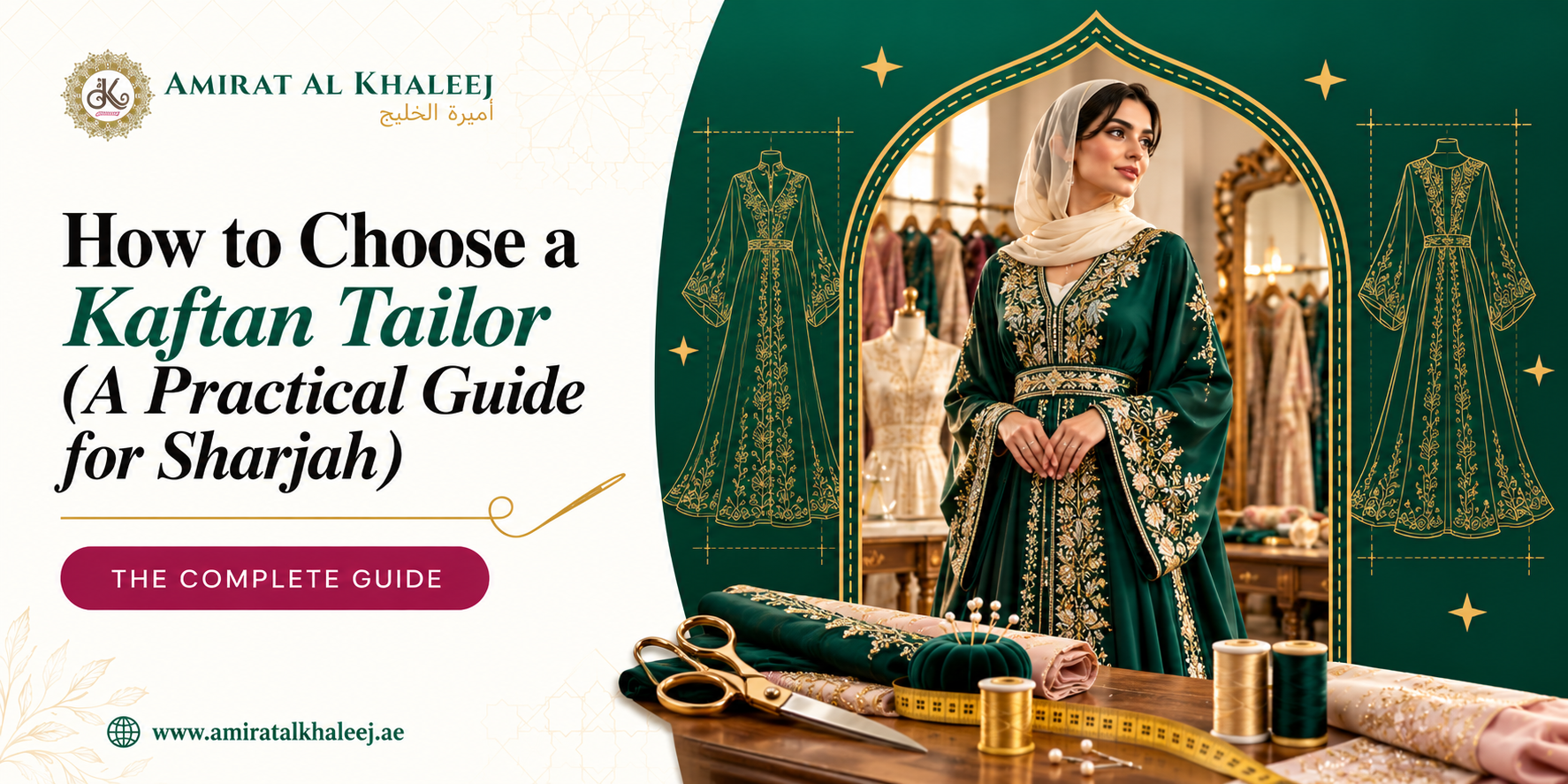
Ask anyone, and they’ll say a kaftan is the easiest thing to stitch. No darts, no zip, just a big loose shape.
We wish that were true. Kaftans come into our alterations counter more often than you’d think, usually pulling at the back or with a hem that’s longer on one side.
Then there’s the embroidery. Thread lifting off a neckline after just a couple of wears is something we see far more than we’d like.
Our honest advice is to take your time choosing a kaftan tailor in Sharjah. Talk to them first and look properly at their sewing. The fabric can stay in your bag until you’ve made up your mind.
Below is whatever we’d normally say if a cousin rang us up for help. There’s a bit on what to inspect, some questions worth asking, price ranges, and the signs that you should leave.
What Is a Kaftan?
Basically, it’s a long robe that’s cut roomy, and the sleeves are wide enough that you hardly notice you’ve got them on.
Kaftans go back a long way. Britannica traces them to ancient Mesopotamia; the Ottoman court handed richly made kaftans to honoured guests, and in the Gulf both men and women wore their own style.
You’ll still see them all over Sharjah’s malls today. Mums do the school run in plain cotton ones, iftar brings out quieter shades, and Eid is when the sparkly ones appear.
Wedding and henna-night kaftans? Those are their own category, heavy with stones and handwork.
Kaftan vs Jalabiya vs Maxi Dress
Customers mix up these three with us all the time. No shame in it, the lines are blurry.
| Aspect | Kaftan | Jalabiya | Maxi Dress |
|---|---|---|---|
| Cut | Wide, often T-shaped, with wide or batwing sleeves | Long robe, sewn-in sleeves, usually a worked neckline panel | Shaped bodice, long skirt |
| Fit | Loose all over | Loose, but a bit more structured | Follows bust and waist |
| When people wear it | Daily, Ramadan, Eid, weddings | Ramadan, Eid, family visits | Dinners, parties, holidays |
| Usual fabrics | Chiffon, georgette, crepe, silk, linen | Crepe, cotton, satin | Jersey, crepe, chiffon, cotton |
If comfort is the priority, get a kaftan. Prefer something traditional with a bit of shape, go jalabiya. Want it to show your figure? That’s a maxi.
Why the Right Kaftan Tailor Matters
With a kaftan, there isn’t much structure to cover up a bad cut, so any small mistake is right there for everyone to see.
Shoulders first, always. We check them before anything else, because when they’re off by even two centimetres, the kaftan slips or tugs at your back.
People complain about sleeves more than you’d expect. Cut long, they drag through the harees, and cut tight, the whole thing stops feeling like a kaftan.
Fabric is next. Chiffon floats, crepe is heavy, and silk slips all over the table, so a tailor who cuts them all the same way ends up with twisted side seams.
Shop lighting makes everything look better than it is. Flip the kaftan and look at the back of the embroidery, because lots of loose ends there means it won’t survive your washing machine for long.
No one photographs the finishing for Instagram, yet it’s what you feel all day. The hem should be even the whole way round, the seams inside should be closed, and the lining shouldn’t itch.
How to Choose a Kaftan Tailor: 8 Things to Check
Run these past the tailor before any money changes hands. Ten minutes, maybe less.
1. Look at a portfolio of real kaftans, not just photos of fabric
Scroll through most tailoring pages, and it’s fabric, fabric, fabric. Lovely rolls of lace, and not one finished seam.
Ask to see photos of kaftans they’ve actually handed over, worn by real clients if they have any. From those, it’s easy to tell whether the neckline sits properly and the hem’s level.
If you’re visiting the shop, pick one up and have a look inside it. A tailor who does good work is usually glad you asked.
2. Check their fabric knowledge (chiffon, crepe, silk, linen, georgette)
Test them with an easy one, maybe “does this chiffon need a lining?” If they know fabric, you’ll get an answer before you finish the sentence.
A few notes from us on the fabrics that come up most:
- Chiffon is thin enough to see through, which is why it nearly always gets a lining.
- Crepe has more weight and falls well, and we reach for it a lot for evening pieces.
- Silk is lovely on the skin, though even one drop of water can mark it.
- Linen is what you want in August, as long as you’re fine with creases.
- Georgette feels a little rougher than chiffon, and that actually helps the embroidery hold.
If they can’t tell you clearly how your fabric will behave after it’s cut, it’s probably better to go somewhere else.
3. Assess embroidery and handwork quality
See if they’ll let you turn a sample over. On the back, you want tidy stitching, knots that are finished off, and no threads hanging down.
On the front, check the design matches on the left and right. Run a finger over the stones too, because none of them should shift.
It’s also worth finding out if they do the handwork in the shop or send it elsewhere, since outsourced work tends to take longer.
4. Ask how they take measurements and how many fittings are included
Bust, waist, and length on their own won’t do it. With kaftans, the shoulders and arms are where the fit gets decided.
Find out how many fittings are in the price. One at minimum, though for anything heavily embroidered we’d always go for two.
5. Confirm turnaround times, especially before Ramadan and Eid
Every year, the weeks before Ramadan and Eid are chaos in Sharjah’s tailoring shops, so build that into your plans.
Get the delivery date written on your receipt. If it’s for an occasion, give them a month at least, more if there’s lots of handwork.
6. Understand pricing and what affects it
You’ll sometimes see two kaftans that look identical online, yet one costs a thousand dirhams more. It usually comes down to these:
- the fabric itself, and how many metres it takes
- extras like linings, panels or bell sleeves
- embroidery, and whether a machine or a person did it
- rush fees
- extra fittings
We always hand clients a breakdown. If a shop won’t give you one, that tells you plenty.
7. Read reviews and ask about alterations policy
Read the Google reviews, sure. But the replies to the one-star ones are the part worth reading.
And just ask it outright: if it doesn’t fit on pickup day, do you fix it free?
8. Test communication: do they listen to your design ideas?
Show them a screenshot, a sketch on a napkin, whatever you’ve got.
The good ones get curious. They’ll ask how you plan to wear it, or tell you that neckline won’t hold up in your fabric and offer another.
If instead they rush you or keep steering you to their own idea, picture how that goes when there’s a problem.
Embroidery Options for Every Budget
Most of the price gap between two kaftans sits in the embroidery, so here’s what each type actually gets you.
| Technique | What it looks like | How it holds up | Good for |
|---|---|---|---|
| Machine embroidery | Clean and even, can look a bit flat on big designs | Washes well | Everyday and Ramadan |
| Hand embroidery | Raised and textured, slightly imperfect in a nice way | Lasts years if done properly | Eid, family events |
| Beads and sequins | Catches the light, adds movement | Fine if hand-sewn; keep it out of the machine | Eid nights, parties |
| Stone work | The most dramatic sparkle | Sewn-on stones last; glued ones often don’t | Weddings, henna, bridal |
Rough price tiers in AED
| Tier | What you usually get | Rough price (stitching + embroidery) |
|---|---|---|
| Budget | A simple design with a little machine embroidery on the neck or sleeves | AED 250–500 |
| Mid-range | More machine embroidery or some handwork, plus a lining | AED 500–1,200 |
| Premium | Lots of hand embroidery, beads or stones, on better fabric | AED 1,200–3,500+ |
Treat these as ballpark numbers for Sharjah. The fabric and design you choose will push the final price up or down.
How to get a rich look on a smaller budget
There’s no need to embroider the entire kaftan. We usually suggest the neckline or cuffs, maybe a panel down the front, since that’s where people’s eyes land first.
Mixing methods helps as well. When the base pattern is machine-done, and a few beads go on by hand afterwards, people assume you paid far more.
Textured fabric is another shortcut. Jacquard or shimmer chiffon already looks rich, so it needs very little added on top.
One last tip: order early, because Eid rush charges can cancel out whatever you saved.
Questions to Ask a Kaftan Tailor Before You Order
Save this on your phone for the appointment.
- Could I see a finished kaftan, including the inside?
- Which fabric would you pick for this, and why that one?
- Do you do the embroidery here? By hand or machine?
- How many fittings do I get?
- Will you write the delivery date down for me?
- Can you break the price down, with any rush charge?
- If it doesn’t fit on pickup, what then?
- What’s the deposit, and is it refundable?
Red Flags to Avoid
Any of these and we’d honestly walk away.
- They skip the fitting completely. Measuring once and sewing blind isn’t tailoring.
- The price is a shrug. “We’ll see” turns into a bigger bill every time.
- No samples, only Pinterest pictures.
- A tight deadline with no plan behind it. Rush work is possible, but a good tailor tells you exactly what can and can’t be done in that time.
- They push you to pay right now.
- Ask about alterations, and they change the subject.
Choosing a Tailor for Other Occasion Wear
Most of this list works for any outfit you’re having made. What really changes is how much structure goes into it, and how many times you’ll be back for fittings.
Gowns
Think of a gown as the formal one: floor-length, fitted on top, worn to weddings and big evening events.
Underneath there’s boning, darts, and sometimes a full corset. Pick someone who’s good with patterns, and expect two fittings at least.
Read next: How to Choose a Gown Tailor, or see our gown stitching service.
Bridal Wear
Bridal covers more than the wedding dress. There’s the henna outfit, the nikah, the reception, sometimes all from one tailor.
It’s the trickiest work we do. Plan on three fittings or more, and start a few months out.
Read next: How to Choose a Bridal Wear Tailor, or see our bridal wear service.
Maxi Dresses
A maxi fits closer than a kaftan does. What you’re really checking is the bust, the waist, and the way the skirt moves when you walk.
Have a look at their zips and hems on thin fabric. That’s usually where a rushed job gives itself away.
Read next: How to Choose a Maxi Dress Tailor and Best Maxi Dress Tailor in Sharjah, or see our maxi dress service.
Jalabiyas
Jalabiyas are very close to kaftans, except the sleeves get sewn in. Most of the embroidery usually goes on the panel at the neckline.
Make sure that panel sits dead centre, and the neck is finished cleanly on the inside.
Read next: How to Choose a Jalabiya Tailor, or see our jalabiya collection.
Looking for the Best Kaftan Tailor in Sharjah?
We’re Amirat Al Khaleej, a tailoring and hand-embroidery studio on Abdullah Bin Salam Street, and honestly, the checklist above is how we try to work every day.
First, we’ll want to know where you’re wearing it and how much you move around in it. After that comes the cutting, the fitting, and the finishing, all done carefully.
A few things our clients tell us they like:
- Fittings are part of the price, and we don’t hand anything over until it fits properly.
- Our team speaks Arabic, Hindi, Urdu, and Bengali, so you can explain your design in whichever language feels easiest.
- Embroidery is done in-house, from neat machine work to full handwork with silk and gold thread.
- When an occasion sneaks up on you, there’s a 48-hour rush embroidery service and doorstep delivery across the UAE.
- Over 5 years, we’ve stitched for more than 2,000 clients, many of them driving in from Dubai, Ajman and Abu Dhabi.
Want to see real pieces before you visit? Have a browse through our kaftan collection.
- Where to find us: Abdullah Bin Salam Street, near Darwish Mosque, Al Mujarrah (Al Sharq), Sharjah
- Who comes to us: clients from all over Sharjah, plus plenty who drive in from Dubai, Ajman, and Abu Dhabi
- When we’re open: Saturday to Thursday, 8 AM to 12 PM and 4 PM to 11 PM. Closed on Fridays.
- Call or WhatsApp: +971 56 722 6191
Have something in mind already? Book a consultation, or just message us on WhatsApp and tell us what you’re picturing.
FAQs
How much does it cost to stitch a kaftan in Sharjah?
A basic kaftan with a bit of machine embroidery usually comes to somewhere around AED 250–500.
Once the embroidery gets more detailed, you’re looking at AED 500 to 1,200, and heavy handwork can cost over AED 3,500.
How many days does it take to stitch a kaftan?
If it’s simple, give it a week or two.
Pieces with plenty of hand embroidery or stone work need three to four weeks, and a bit more in the Eid season. Short on time? Ask about our 48-hour rush embroidery service.
Can I give my own fabric to a tailor in Sharjah?
Yes. Most tailors are fine with that, and so are we. Just bring the fabric along on your first visit, and we’ll check that you have enough.
How many fittings are needed for a custom kaftan?
For everyday kaftans, a single fitting normally does the job. Eid and wedding pieces are safer with two.
Which fabric is best for a kaftan in UAE summer?
Linen and cotton voile keep you coolest. If you want something dressier, a lined chiffon or a soft georgette works.
Skip heavy satin and polyester in the daytime. You’ll regret it by noon.
How early should I order a kaftan for Eid?
Four to six weeks before, at least. Earlier if it’s heavily embroidered, because the last few weeks fill up fast.
What is the difference between a kaftan and a jalabiya?
A kaftan is looser with wide sleeves. A jalabiya has sewn-in sleeves and a more structured neckline.
Where can I get a custom kaftan stitched in Sharjah?
Find a studio that shows real finished work, includes fittings, and writes down its prices.
That’s how we work at Amirat Al Khaleej, near Darwish Mosque in Al Mujarrah. Book a consultation or drop us a WhatsApp.
Conclusion
See their real work. Check they know fabric and embroidery. Make sure fittings are included.
Get the price and date in writing, read the reviews, and pick someone who actually listens.
When you’re ready for a kaftan you’ll keep wearing for years, we’d love to make it.