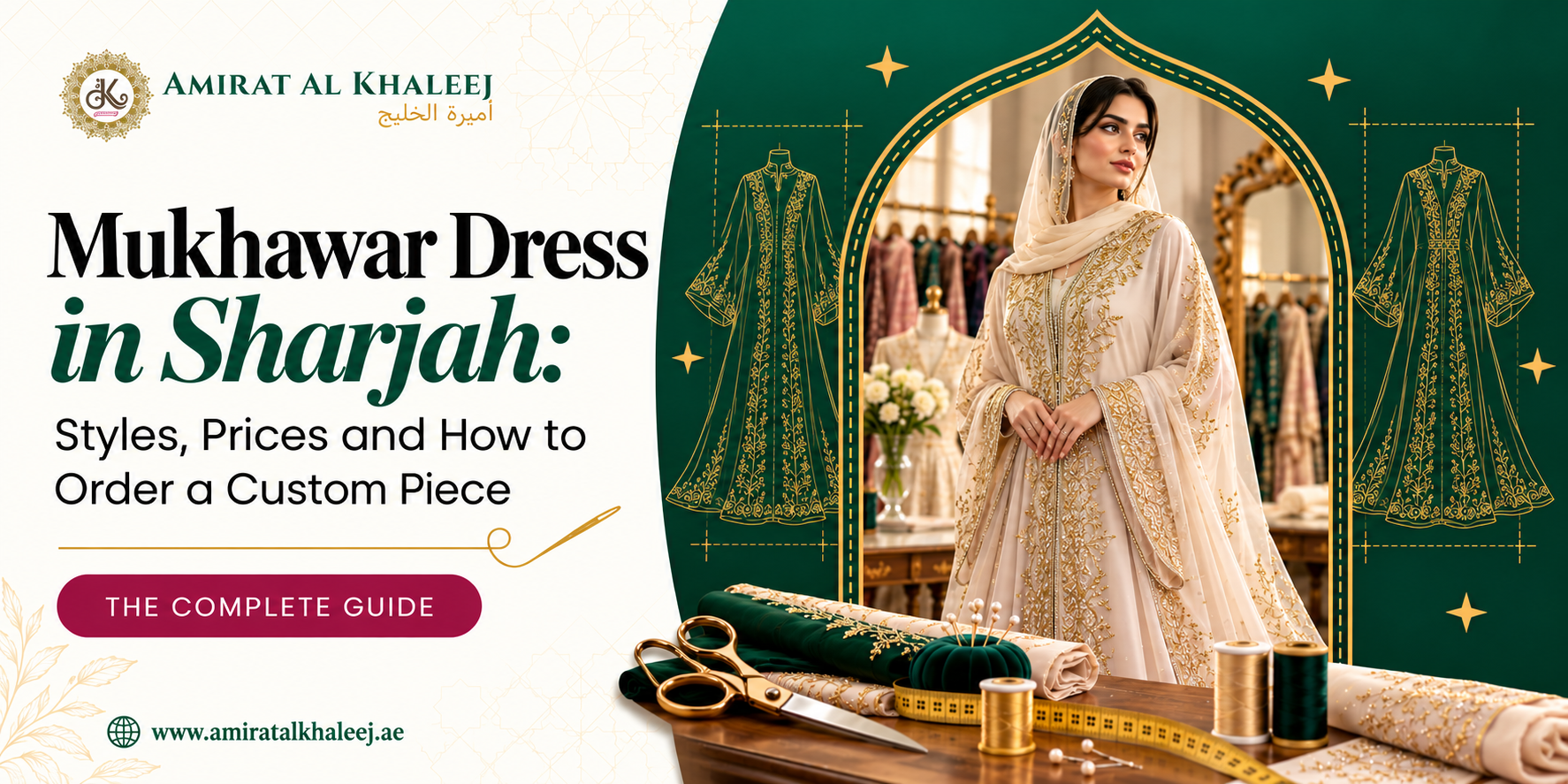
Ask any Emirati woman about her favourite Mukhawar, and she’ll probably tell you a story first. The one her mother had stitched for her first Eid. The green one she wore to her sister’s henna night. That’s the thing about this dress. It carries memories.
We’ve been making the Mukhawar dress in Sharjah for years now, from our little boutique near Darwish Mosque in Al Mujarrah. And the same questions come up again and again. Which style should I pick? What fabric works in the summer? And honestly, how much is this going to cost me?
So we decided to put the answers in one place.
What Is a Mukhawar?
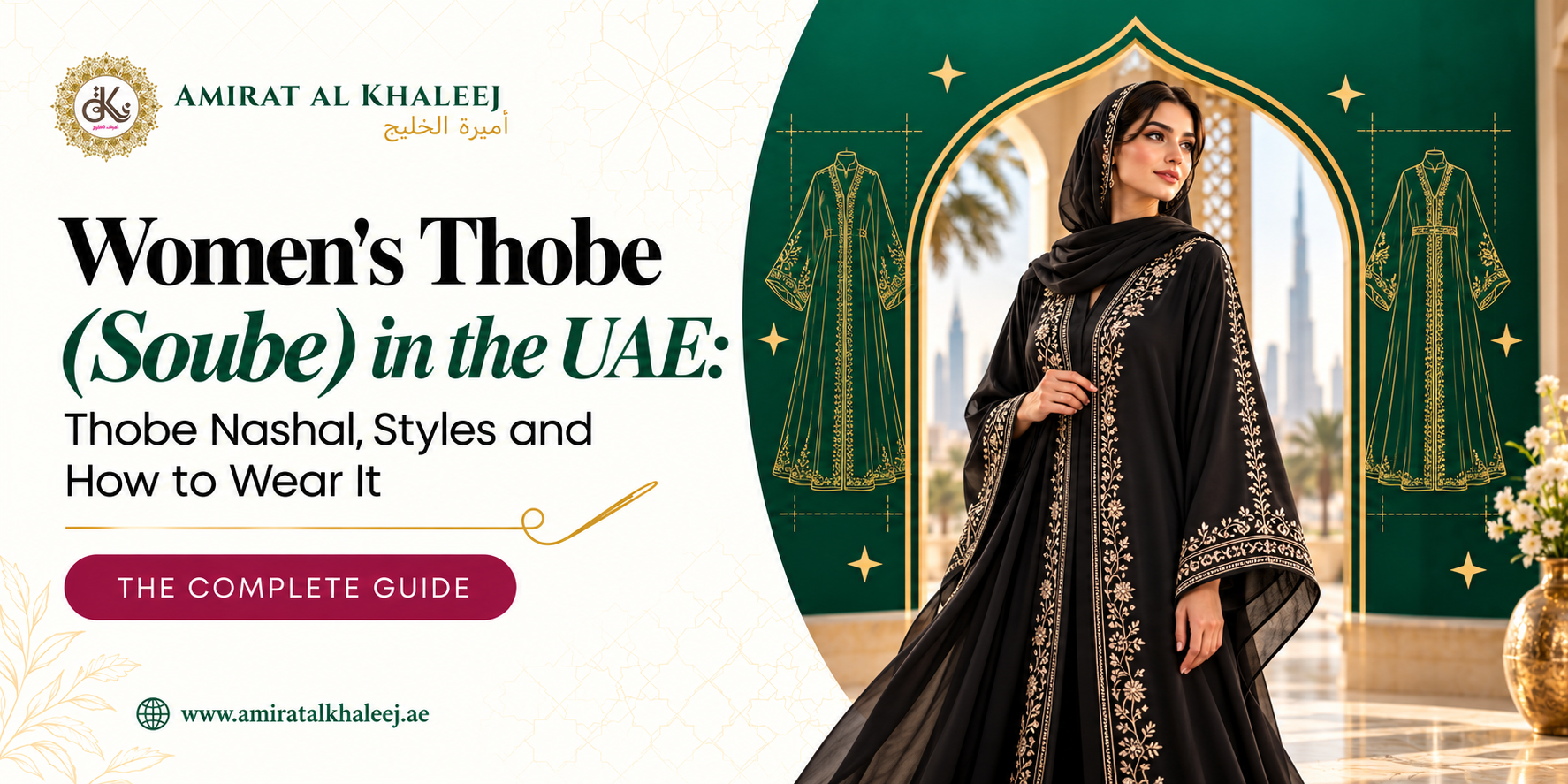
In simple words, a Mukhawar (مخور) is the traditional long dress of Emirati women. It reaches the ankle, the sleeves are full length, and in most cases there is embroidery on the neck and the cuffs. Women here wear it at home, for family visits, for Eid, and many wear it under the abaya when going outside.
One of our regular customers, a lady from Al Khan, once told us her mother had only three Mukhawars in the whole house. Two were cotton for everyday wear, and the third was kept in the cupboard for weddings and Eid.
Today her daughters come to us with photos on their phones, asking for pastel colours, soft chiffon, and a little modern touch on the Talli. The dress is the same dress, but the taste has changed a lot.
Talli embroidery, the detail everyone recognises
If there’s one thing that makes a Mukhawar look Emirati at a glance, it’s Talli (تلي). Talli is a thin braided trim, worked by hand with metallic and coloured threads. Gold and silver are the classics.
It’s slow work. A neckline alone can take hours. But clients keep asking for it, even on modern cuts, because a Mukhawar without Talli just doesn’t feel quite right to many of them. The craft matters so much to the Emirates that in 2022, UNESCO added Al Talli to its list of the Intangible Cultural Heritage of Humanity.
Mukhawar vs Jalabiya vs Kaftan
People mix these up all the time, and fair enough. All three are long and modest. But they’re not the same dress.
| Garment | Where it comes from | How it’s cut | How it’s usually decorated | When women wear it |
|---|---|---|---|---|
| Mukhawar | The Emirates | Long and loose, fitted sleeves | Talli at the neck and cuffs | Eid, home, under the abaya |
| Jalabiya | Across the Gulf and Arab world | Flowing, often wider sleeves | Beads, stones, embroidered panels | Parties, henna nights, Eid |
| Kaftan | Middle East and North Africa | Very loose, wide or open sleeves | Anything from plain to heavily worked | Lounging, evenings out |
Lately we get a lot of requests for a Mukhawar Jalabiya. It’s basically a Mukhawar shape with Jalabiya-style decoration. Traditional, but with a bit more sparkle for a celebration.
4 Popular Types of Mukhawar Dress in Sharjah
Everyday Mukhawar
This is the one you’ll live in. Light, breathable, easy to throw in the wash. We usually suggest cotton blends or a soft crepe, with a simple trim at the neck. In August, under an abaya, you’ll be glad you went light.
Embroidered Mukhawar
For a lot of our clients, this is what a Mukhawar should be. Talli or hand thread work frames the neckline, the cuffs, and sometimes the hem. We sit down and agree on the design together before a single stitch goes in, so yours won’t look like anyone else’s.
Eid and occasion Mukhawar
Eid is when we’re busiest, by far. Occasion pieces go bolder: deeper colours, richer fabrics, fuller embroidery, maybe some stones. These aren’t meant to hide under anything. They’re the outfit.
Bridal Mukhawar
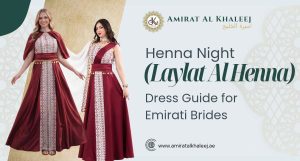
Many of the brides who visit us want a Mukhawar for the days around the wedding rather than the wedding night itself. They wear it to the family lunches, the henna, and the evenings when relatives come to the house.
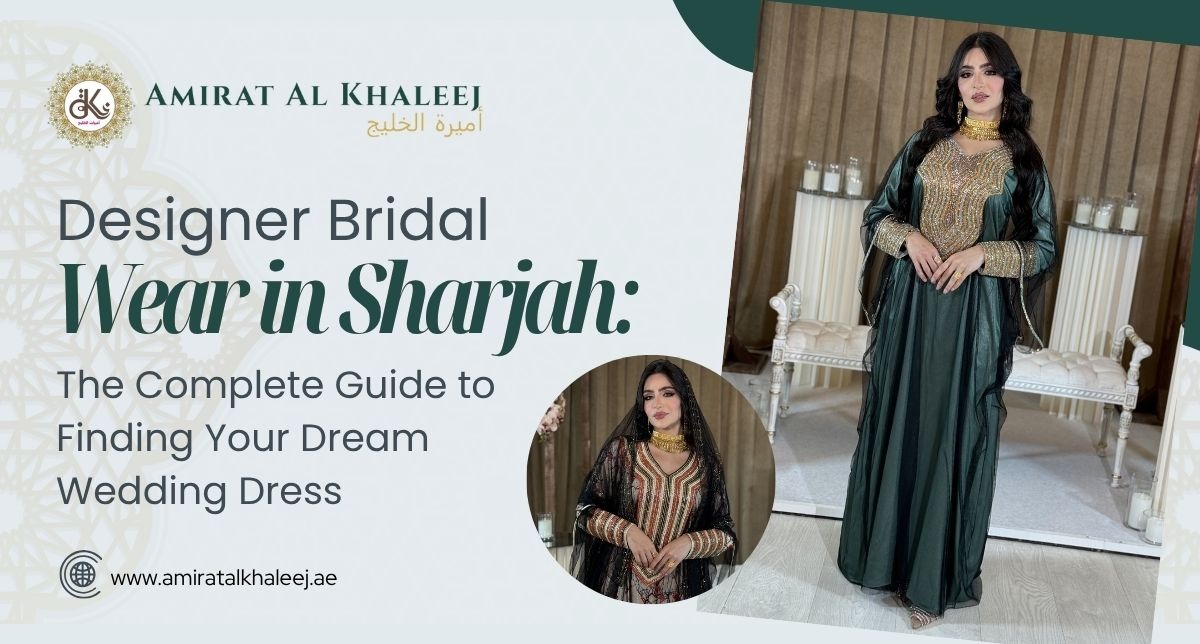
Because of that, a bridal Mukhawar is usually made in a better fabric than an everyday one, with more hand embroidery, and we book at least two fittings for it. If the bride is also having her bridal gown made with us, we plan the colours of both pieces at the same time so they sit well together in photos.
Choosing the Fabric and Embroidery for Your Mukhawar
Choosing fabric for a Mukhawar dress in Sharjah is mostly about the heat. It is the first thing we discuss with every client, because in summer the wrong fabric becomes uncomfortable within an hour.
If the Mukhawar is for home, we normally suggest cotton or a cotton mix. It is cool, simple to wash, and it lasts. Some ladies prefer crepe instead, as it falls nicely on the body and does not get creased even after sitting the whole evening at a family dinner.
For Eid and weddings, the choice usually goes to chiffon or georgette, and we put a lining inside so it is not see-through. Those who want a little shine pick silk or satin. We stitch velvet mostly between December and February, when the nights get cold enough for it.
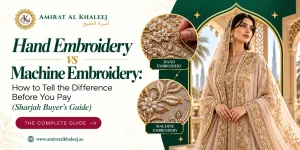
For the embroidery, the main options are Talli trim, hand thread work, zari done in metallic thread, and stones or beads. An embroidered Mukhawar finished by hand will cost more and take longer than one done on a machine, because a single Talli neckline can take one of our embroiderers most of a day.
Clients who have worn both usually tell us the handmade one feels softer and looks richer up close. You can see some of our recent pieces on the hand embroidery page.
Got your own fabric at home? Bring it in. We’ll tell you honestly if it suits what you have in mind.
How Much Does a Mukhawar Dress in Sharjah Cost?
Short answer: a Mukhawar dress in Sharjah can cost anywhere from about AED 150 for a simple everyday piece to AED 4,000 or more for a hand-embroidered bridal one. Most custom embroidered Mukhawar orders we see land somewhere between AED 300 and AED 1,500.
The longer answer is that Mukhawar prices depend on three things: the fabric, the embroidery, and how much of the dress it covers. Here’s a general guide.
| Mukhawar type | Rough price (AED) | Usual turnaround |
|---|---|---|
| Everyday Mukhawar | 150 – 350 | 7–10 working days |
| Embroidered Mukhawar (Talli or thread work) | 300 – 800 | 12–18 working days |
| Eid or occasion Mukhawar | 500 – 1,500 | 10–18 working days |
| Bridal Mukhawar | 1,500 – 4,000+ | Book 4–6 weeks ahead |
| Stitching only, with your fabric | from 120 | 7–14 working days |
| Alterations | from 30 | 1–5 days |
Think of these as ballpark figures. We confirm your exact price at the consultation, before we cut anything.
Why two Mukhawars can cost so differently
Silk and velvet cost more than cotton. That one’s obvious. Embroidery is where prices really move, though. Hand Talli on a neckline is one thing; Talli plus zari on the sleeves, hem, and front panel is several days of someone’s work. Stones and crystals add both material and time. And if you need it in 48 hours for a wedding you forgot about (it happens!), a rush fee may apply.
One thing we’re strict about: the price we agree is the price you pay. It only changes if the design changes.
How to Order a Custom Mukhawar
You can start from your phone and finish with us in Al Mujarrah. It usually goes like this:
- Send us a WhatsApp message with the occasion, a few reference photos, and your budget.
- We talk through fabric, cut, sleeves, and embroidery, then confirm the price.
- You come in for measurements. Our fitting room is private and women-only.
- We cut, stitch, and embroider your piece in our Sharjah workshop.
- You try it on, we fix anything that isn’t perfect, and you take it home (or we deliver).
Most Mukhawar tailoring in Sharjah takes 7 to 14 working days with us. Heavy hand embroidery needs 12 to 18 days. For simpler pieces, we can sometimes manage 48 hours, depending on how busy we are. Just ask.
Why Women Keep Coming Back to Us
We’re a women-only boutique, start to finish. The staff is women, the fitting room is private, and nobody walks in on you mid-measurement. When women look for a Mukhawar dress in Sharjah, privacy is often the first thing they ask us about.
Everything is made to your measurements, not adjusted from an S, M, or L. The embroidery happens in our own workshop, and you see and approve the design first. You’ll know the price before we start. And if Arabic isn’t your first language, no problem: our team also speaks Hindi, Urdu, and Bengali.
We have regulars who drive in from Dubai, Abu Dhabi, and Ajman. For everyone else, we deliver across the UAE.
Questions We Get Asked a Lot
Is a Mukhawar the same as an abaya?
No. A Mukhawar is the dress itself, worn at home, at gatherings, or underneath. An abaya is the loose outer cloak, usually black, that goes over your clothes in public.
Can I buy a Mukhawar online?
Yes, at least the first half. You can buy a Mukhawar online with us by starting on WhatsApp: share your ideas, photos, and budget. We’ll still need you in the boutique once for measurements, because a good fit depends on it.
When should I order my Eid Mukhawar?
Three to four weeks before Eid, minimum. The last fortnight before Eid al-Fitr and Eid al-Adha gets very busy, and slots fill up fast.
Can you copy a design from a picture?
Of course. Send us the photo, and we’ll make it in your fabric, to your size.
Where to Buy a Mukhawar Dress in Sharjah
If you’ve been thinking about a new Mukhawar dress in Sharjah, drop by. We’re on Abdullah Bin Salam Street, near Darwish Mosque in Al Mujarrah. Saturday to Thursday, 8 AM to 12 PM and again 4 PM to 11 PM. Fridays, we’re closed.
Or message us on WhatsApp or call +971 56 722 6191 and tell us what you have in mind. Want ideas first? Browse our Mukhawar collection.